Friday, 29 July 2022

Maurice Madden's Last Day - Friday 02 July 1915 Nether Edge Sheffield - an Update

Earlier this year I posted an article to the site with the title "Maurice Madden's Last Day - Friday 02 July 1915 Nether Edge Sheffield"

It was a family tragedy that received widespread coverage in the local press due to the fact that Maurice was only ten years old when he was involved in a collision with a motor vehicle near his home in Montgomery Road, Nether Edge Sheffield


This afternoon I was going through some old magazines, one of which was the local advertising magazine called "Grapevine." In the January 2021 edition there was this article that was submitted by Mr. Jason Heath of John Heath and Sons. It refers to a photograph that was taken in Montgomery Road, Nether Edge, Sheffield by the company  some hundred years ago. There were no details on the photograph but a couple of local residents definitely identified the houses and the road as being Montgomery Road, the same road were the Madden family lived and died. 

Of course you can never be sure but the funeral could well be that of either the son Maurice who died in July 1915 or his father who died two years later in July 1917. Apart from the location the fact that the aforementioned trees are in leaf would point a funeral that took place in summer rather than winter. 


Tuesday, 28 June 2022

Queen Elizabeth 11 Last Visit to Sheffield - Thursday 18th November 2010

 From the Sheffield Star dated Wednesday 17th November 2010


Her Majesty was accompanied by her husband Philip, Duke of Edinburgh and I am pretty sure that this was his last visit to the city prior to his death on 9th April 2021.

The photo below is Sitran which is part of the University of Sheffield and was opened officially by the Queen  on Thursday 18th November 2010

It is opposite the Royal Hallamshire Hospital on Glossop Road and is adjacent to what was Hanrahan's and later Loch Fyne's 


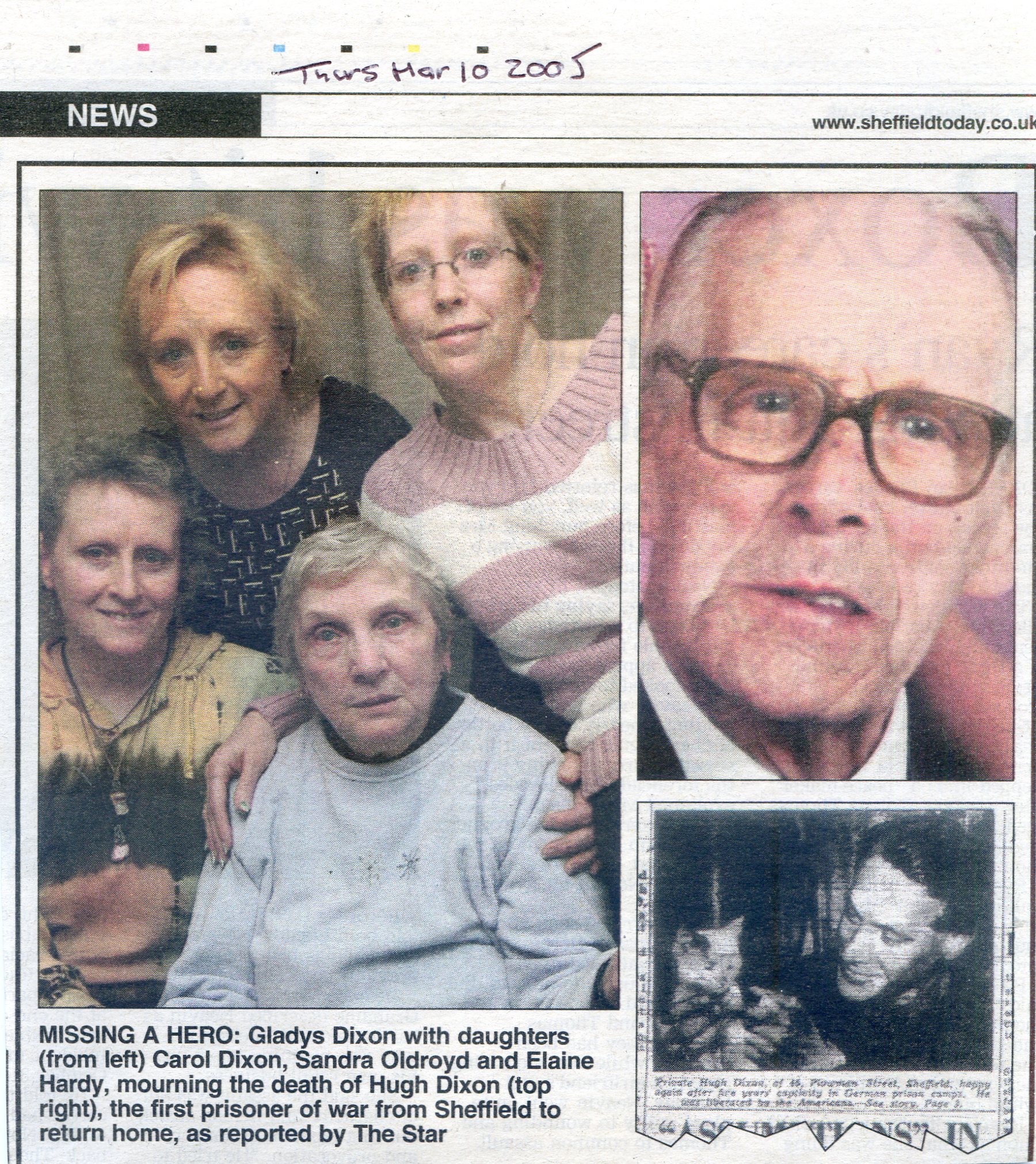
Hugh Dixon - the first prisoner of war to return home to Sheffield 1945

 I came across this article from the now defunct Sheffield Weekly Gazette dated Thursday 10th March 2005. It relates to the death of Hugh Dixon who died at the age of 84. In the article it refers to the fact that Hugh was the first prisoner of war to return home to Sheffield in 1945. 


 It is a harrowing story of Hugh's captivity at the hands of the Nazi's. There is an article that was written in the Sheffield Star dated 12th April 1945 that may furnish further information and so I have made a note of it for my next trip to the Local Studies Library   

Monday, 27 June 2022

The Funeral of Squadron Leader Ken "Hawkeye" Lee (1915 - 2008)

 This cutting is from The Sheffield Weekly Gazette dated Thursday 7th February 2008 and refers to the funeral in Sheffield of Squadron Leader Ken "Hawkeye" Lee (1915 - 2008), one of "The Few" 


There is also a book that has been written about Ken 

Kenneth 'Hawkeye' Lee Battle of Britain Ace: Battle of Britain & Desert Air Force Fighter Ace Hardcover – 17 Feb. 2011
by Nick Thomas  (Author)

Following training Hawkeye Lee received his commission and was posted to 501 Squadron which was sent to support the Expeditionary Force in France, arriving on 10 May, only hours after the Blitzkrieg had been launched. Lee quickly opened his score, claiming several bombers during the first week of operations. Having been wounded when his Hurricane exploded following a dogfight, Lee was briefly rested but soon rejoined the Squadron before they moved to their first Battle of Britain base at Middle Wallop. Lee scored more damaged and destroyed enemy aircraft and by the end of July he was Mentioned in Dispatches. Lee was forced to take to his parachute for the second time. He later recalled how each of the Squadron s aces , even Ginger Lacey, had been shot down at least twice during that summer. Lee was later posted to 112 (Shark) Squadron, flying Curtis Kittyhawks on Fighter and Fighter-Bomber missions in North Africa and then to 260 Squadron which was heavily involved in the lead-up to the battle of El Alamein, seeking out and destroying enemy troop columns and fighting off the Luftwaffe which still had air superiority. In March 1943, 123 Squadron began Fighter-Bomber operations against Mediterranean targets, during one Lee was hit by AA and made a forced landing in an olive grove. He was captured and sent to Stalagluft III just in time to play a key role in the Great Escape.


Friday, 27 May 2022

Images of the Sheffield Flood - March 1864

I have never written about the Sheffield  Flood of March 1864 on the grounds that the tragedy was well covered both in print and on-line and there was nothing really I could add to the narrative. Two of my wife's ancestors had their businesses and property damaged and made successful claims but so did many others.

However quite a few years ago a neighbour gave me the following photocards of the disaster. He had had them in his possession for some years and seemed to believe that they were taken initially from lantern slides taken at the time of the disaster.  


Images of the Sheffield Flood - March 1864


Sheffield Whitsuntide Fair - May 1869

This is a report from the Sheffield Daily Telegraph dated 19th May 1869 and refers to the annual Sheffield Whitsuntide Fair that was held 153 years ago this week

Sadly the print and image quality is poor and so this is a transcription of the report - apologies for any errors. The other amusing part of the report is the jaded recollections of the reporter who was sent to view the affair. Apart from the Queens Menagerie from Wombwell he was not at all impressed by the event!

"SHEFFIELD WHITSUNTIDE FAIR. 

The Sheffield Whitsuntide fair of 1869 is precisely similar to that of last year, and to those of twenty years previous. There are same novelties to attract not only the attention of youth but even children of larger growth. There is food for the body and food for the mind. You "simply pay your money and take your choice." 

Should you feel hungry and wish to dine economically score of portly purveyors are at your service, and having replenished the inner man the vulgarities of the " noble art of self defence" claim your patronage. In their saloon, for the trifling charge one penny, the human face divine can be beaten to a pulp with the gratifying knowledge that it has been accomplished by the renowned Ben Caunt, —the world famed Molyneaux, or the ever-to-be remembered rival of Tom Sayers. 

Next you have the Hottentot Venus, a peculiar specimen of humanity weighing sixty stones, more or less, who might have been considered " a beauty had not itinerant showmen recently introduced to the British public the French Giantess whose colossal dimensions we should be afraid to describe. 

Tbe man who rejoices in the possession of three legs and thirty toes should not be permitted to pass his days in solitude. So his keepers are of opinion, and during the time he is " on view " may be safely computed that it is £2 per hour to their advantage. 

But the most attractive feature in the whole fair is the Queen's Menagerie, Wombwells Royal No 1. This noble collection has been several times exhibited in Sheffield, and on each occasion has received well-deserve patronage. is one of the largest in Europe, and comprises lions from South Africa and Barbary, tigers from the haunts of India, leopards from the Cape, the ocelot from Chile and Mexico, tibetan sun bear and the polar bear, the Tasmanian devil from Van Dieinan's Land, wolves from Egypt and Lapland, elephants from the southern part of India, and host of other wild and tame animate and birds, which to the student of natural history as well as to the public at large, must prove interesting and instructive. 

The quantity of provisions necessary for the animals in this establishment is very large. The carnivorous or flesh eating animals require about 2 cwt. of meat daily, and it composed generally of bullock's shins, hearts, and heads; lion requires about 121bs. of solid flesh; tiger about the same, a leopard 51bs.; bears are fed almost exclusively on bread and sop; monkeys on rice, bread, sop, and fruits; and the herbivorous animals are fed much the same as horses. As a proof of the excellence of the menagerie it may be stated that it has been patronised by Royalty on four separate occasions. 

There are other attractions "too numerous to mention," all of which, no doubt, will have sight-seers galore. The horse fair was not nearly so well attended as previous years, nor were the animals offered for sale much value. They were mostly cart horses, but the demand was very limited. The cheese fair was an equal failure. There was not one fifth of the usual quantity exhibited, and of little not more than half was sold. Cheshire thicks realised from 80s. to 95s and Derby cheeses from 80s. to 90s.


The Death of William Blackshaw, Sheffield Union Workhouse December 1882

 In Sheffield's City Road Cemetery there is a public grave (Grave Number 11933, Section X) that houses 14 bodies. Most of them died at their own addresses in Sheffield but all were so poor they could not afford to pay for a grave. One of the persons in the grave is William Blackshaw and this is his burial record

Blackshaw, William (Cutler, age 40). Died at Union Workhouse; Buried on December 13, 1882 in Consecrated ground;  Grave Number 11933, Section X of City Road Cemetery, Sheffield.

He died in The Sheffield Union Workhouse but the manner of his death caused a great deal of consternation at the subsequent inquest.

This is the report from the Sheffield and Rotherham Independent dated December 19th 1882. As a footnote opium tincture or laudanum was widely used in the 19th century as a pain killer or sleeping aid; it was highly addictive, leading to many of its users forming a drug addiction.


 Nurse Thompson was censured for her neglect which was self evident from the report but for the Coroner to threaten her with a charge of manslaughter was a over the top but he obviously thought it was warranted


Sunday, 24 April 2022

Places in Time - The Art of Kenneth Steel - Sheffield December 2021 - May 2022

 Many years ago I posted an article to the site relating to the life and work of a Sheffield artist Kenneth Steel  At the timer I had never heard of him and there was hardly any information either on-line or in print. But he had an interesting life that had more than its share of tragedy and sadness.

Since then awareness of his work has increased and over the last four months there has been an exhibition of his work at Sheffield's Weston Park Museum.

I visited the exhibition yesterday and to be quite truthful I was staggered by the number of exhibits and also the quality as well. It was very well laid out and informative. I just did not realise how prolific Kenneth was as an artist and also the range of his works. I did not know about his Mallorcan and Mediterranean works and so that was a bonus. 

All in all the exhibition did Kenneth proud and I hope it does bring his life and works to a wider public. 

Kenneth now has a dedicated website that vividly portrays his works and so is well worth a visit

The exhibition closes on Monday 2nd May 2022 and so there is only one week left to visit it.


Friday, 22 April 2022

Loxley Cemetery Sheffield Open Day - Monday 2nd May 2022

 A friend has asked me to post the following flyer on my blog. The event is for an Open Day on Bank Holiday Monday 2nd May 2022 at Loxley Cemetery Sheffield 


Friday, 8 April 2022

The Tormented and Appalling Death of Ellen Thorpe - Sheffield November 1881

 I have just posted an article to the site entitled "The Tormented and Appalling Death of Ellen Thorpe - Sheffield November 1881" It was based on a cutting that I had from the London Times dated 7th December 1881 and relates to the death of 12 year old ELLEN THORPE.


The Sheffield Coroner stated that it was "the most abominable case of ill-treatment he had ever known" and severely admonished the father JOHN THORPE for his conduct and actions.. The Coroner did take the matter further but the eventual outcome was not what he and the jury had in mind when they delivered their verdict.

Note The insurance of £5GBP that he was due to as a result of her death is about £425 in todays money


Wednesday, 6 April 2022

Sgt. G H Newman was hacked off in Gallipoli - October 1915

 A researcher contacted me last week with this query

"I am currently doing a tidy up for the Sheffield Soldiers on the Gallipoli Campaign . It is taking longer than I thought as quite a few casualties are listed as Mediterranean ,Balkans or died at sea so have to wade through to see where they actually died  . 

Anyway came across an interesting little aside . Sheffield Evening Telegraph 2/10/1915 P4 In a letter from a Sgt G H Ramsden 6th Y & L  he seems to be unhappy about the status of other Sheffield soldiers . " Our battalion comes from Sheffield and Sheffielders have forgotten about them for their pets the Sheffield City Battalion " 

This is the first time I have ever come across any resentment towards them ,have you noticed anything.

I certainly had not and so I checked the article from the Sheffield Evening Telegraph


The print is not very good for this blog and so I have transcribed the article below

YORKSHIRE BRIGADE. 

Hard Task in Dardanelles Landing. 

The Editor has received the following letter from Sergeant G. H. Ramsden, York and Lancaster Regiment, somewhere in the Mediterranean, asking Sheffielders not forget them : Just line to let you know how proud Sheffielders ought to be of the boys from the old place. We had to make a new landing, and the Yorkshire brigade had a hard task, but did it wonderfully well. Although lost terribly, we managed to drive the Turks back five miles, but it was awful work. Rifle and shrapnel fire killed and wounded many of our brave fellows. We are present holding trench on tlhe front, many of us not having had time for a wash after 10 days of stiff fighting. I don’t know how much longer we shall be here before are relieved, but we are about worn out, not having had a night's sleep since we landed. Our battalion mostly comes from Sheffield, and the boy say that the Sheffielders have forgotten them for their pets — the City Battalion. However, as Sheffielders yet, so don’t forget the boys out here, as we cannot buy any “cigs,” and have to depend what they give us

Sheffield Evening Telegraph - Saturday 02 October 1915

The researcher and myself pondered the class angle which may be part of the bitterness but we think the following may be the main reason for the resentment that the lads in Gallipoli felt towards the City Battalion

I replied

"Attached are my findings - I do not have access to the Folio 3 (WW1 Pension) on Ancestry but have a transcript which is transcribed below.  

I am sure that  he is one and the same as the letter writer and in civilian life he was working class. He does mention in the letter that most of his battalion (6th York & Lancs) were Sheffielders but if you contrast the disaster that they were experiencing in Gallipoli with the military activities (and publicity) of the Sheffield City Battalion in 1915 you can plainly see why they were hacked off a treat."

Although the Sheffield City Battalion was supposedly open to all it had a strong representation of the professional and commercial classes and they spent 1915 in the UK at various training camps rather than at the front line

What Sgt Ramsden and his lads did not know was what awaited the Sheffield City Battalion the following year

Notes

George did make it back to the UK but with a disability - he died in 1948 at the age of 69 

WWI Pension Record Cards and Ledgers

Name: George Harry Ramsden
Rank: Sgt
Record Type: Disability
Birth Date: 1878
Residence Place: Attercliffe Sheffield 
Military Service Region: Yorkshire, North East Military Country: England
Discharge Date: 10 Apr 1919
Service Number: 682340
Corps, Regiment or Unit: Labour LCNC Service Branch: Military (Army)
Title: WWI Pension Record Cards and Ledgers
Description: PRC Ledgers
Reference Number: 70226, 4/MR/No.27
Next of Kin: Name Relation to Soldier George Harry Ramsden

1911 Census


Name: George Harry Ramsden
Age in 1911: 33
Estimated Birth Year: abt 1878
Relation to Head: Head
Gender: Male
Birth Place: Sheffield, Yorkshire, England Civil Parish: Sheffield
Country: England
Street Address: 24 Howden Rd Sheffield
Marital status: Married
Occupation: Joiners Tool Maker
Registration District Number: 510 Sub-registration District: Attercliffe
ED, institution, or vessel: 16 Piece: 28004
Household Members:
Name Age
George Harry Ramsden33
Gertrude Ramsden 33
Annie E Ramsden 8
Mary Ethel Ramsden 4
George Harry Ramsden 2
Bertha Ramsden 3/12

George's burial record  - he is buried alongside his wife Gertrude who died in 1943

RAMSDEN, George Harry (Joiner Tool Maker, age 69).
     Died at 153 Richmond Road; Buried on March 13, 1948 in Consecrated ground;
     Grave Number 1047, Section ~ of Handsworth Cemetery, Sheffield.
     Parent or Next of Kin if Available: . Remarks: Orgreave Lane ground.
    
RAMSDEN, Gertrude (Wife of George H Ramsden, age 63).
     Died at 153 Richmond Road; Buried on April 15, 1943 in Consecrated ground;
     Grave Number 1047, Section ~ of Handsworth Cemetery, Sheffield.
     Parent or Next of Kin if Available: . Remarks: Orgreave Lane ground.

In May 2022 I received further information that re-enforces the notion of the Sheffield City Battalion being "pets", one surprisingly that still exists to this day

""The 6th Battalion Y&L was not in fact a Territorial Army unit but one of hundreds raised on the outbreak of war as Service Battalions.  I am not sure where they were recruited but trained near Grantham,  not in Sheffield.   By WW11 it was a distinguished Territorial Battalion.
I can well understand your comments about the Sheffield City Battalion being the "pets".   I can tell you that that exists to this day.   When the Y&L Monument in Weston Park,  next to Sheffield University,  was cleaned in conjunction with improvements to the Park,  the Council put up a Notice Board all about the Pals totally ignoring the fact that over 8,000 thousand Y&L died in WW1 of which a small number were Sheffield City Battalion.
Your knowledge is certainly correct." 


Friday, 1 April 2022

The Duchess of York's Visit to Sheffield - July 1934

The following two cuttings are from the London Times dated 6th and 7th July 1934 and detail the visit of the Duchess of York to Sheffield in 1934. Her husband the Duke of York (the future King Geoege V1) did not accompany her on this visit due to an indisposition.


There is a marvellous photograph of the the future Queen Elizabeth The Queen Mother digging In Mr J Oliver''s Potato Plot during her visit to The Deep Pits Allotments Of The Sheffield Unemployed. But unfortunately I cannot use it in this blog due to copyright reasons. Well that is not true I could use it but I would have to pay money to some corporate entity that really has no place in copyrighting the image.

As for the The Deep Pits Allotments Of The Sheffield Unemployed I was not aware of the location but they were situated off City Road not far from City Road Cemetery. The 1200 men who contributed to the stainless steel garden fork and hand trowel raised £5.00 which is circa £250 in todays money which seems a touch pricey for the two items. I wonder if they are still being used today! 


Wednesday, 23 March 2022

Shiregreen Cemetery Sheffield - March 2022

It has been widely reported in the media that Shiregreen Cemetery now has the largest headstone in the United Kingdom and has attracted world wide interest. It is the grave of Willy Collins and was erected by the family and many friends of the deceased.

It used over 37 tons of Italian marble and is reputed to have cost in excess of £200,000. 

When I first read the story I was amazed and bewildered. The cemetery is owned and administered by Sheffield City Council who have traditionally imposed strict guidelines on what is and what is not allowed in the 16 municipal cemeteries they control. In fact one of the first blogs I posted was in relation to the Wooden Crosses of Burngreave Cemetery 1930 which even today still leaves an unsavoury taste in the mouth. And since then there has been a constant stream of stories of Sheffield City Council imposing harsh and in many cases unnecessary regulation on the bereaved families.


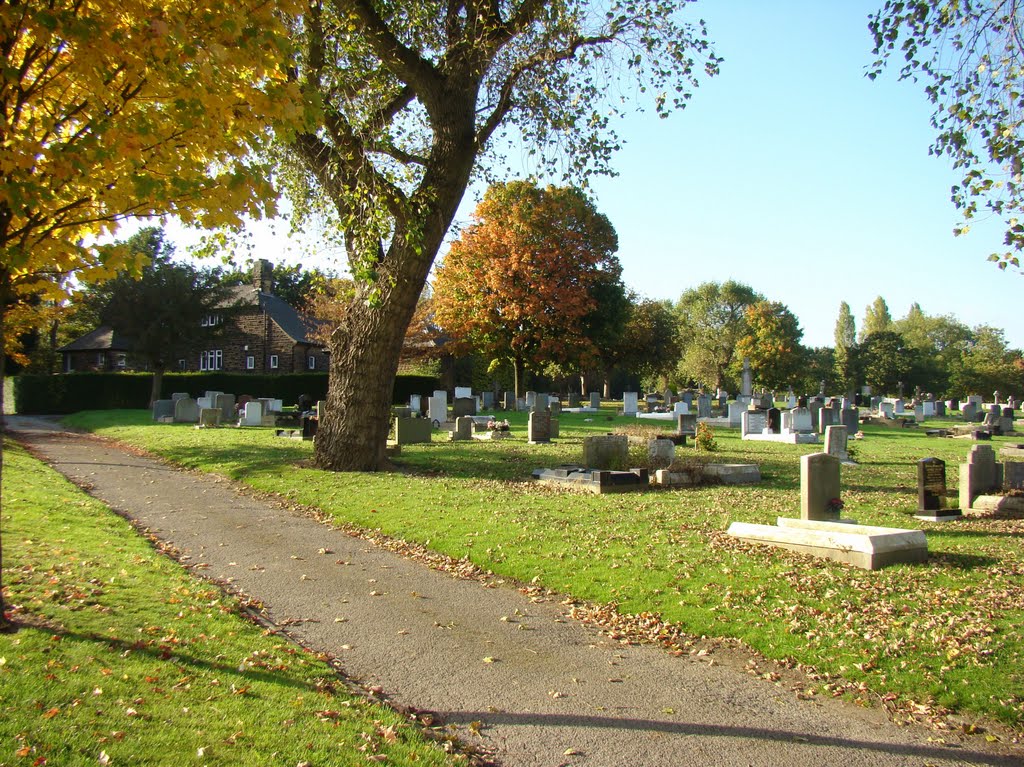
Shiregreen Cemetery Sheffield

But all was revealed when Sheffield City Council announced that the family of Willy Collins had not approached them to ask for permission to erect such a grand memorial. The memorial contravened their regulations in every respect. At the time of writing Bereavement Services at the Council were looking into the matter and had summoned the relatives of the late Willy Collins for a meeting to discuss matters arising for want of a better term.

There is speculation in the press that thw whole memorial will have to be demolished and one erected that complies with the Council's stict rules. But that is just speculation.

The wider point is that Sheffield City Council claims to be ignorant of the erection of the memorial. It must have taken days if not weeks to erect such a grand memorial which seems to indicate that the Council do not know what is going on in their cemeteries. Bereavement Services proudly claim that they are responsible for Shiregreen Cemetery and so it is the Council who should ensure that their regulations are enforced. It appears not for the first time that the Council have been negligent in fullfilling their responsibilities to the people of Sheffield


The Crookesmoor Dam Mystery - Sheffield October 1899

I have just posted an article to the site titled The River Don Tragedy - October 1901 in which a two year old boy named Sydney Talbot was drowned near Hillfoot Bridge by his mother Susannah

At the subsequent inquest and criminal trial reference was made to the death of her brother EDWARD BISHOP two years earlier by drowning in Crookes Dam.

And so I decided to check the details out using the British Newspaper Archive

Sheffield Evening Telegraph - Wednesday 01 November 1899

SHEFFIELD NOTES & JOTTINGS . 

Yesterday afternoon the body of man was drawn from the Ralph Dam, Crookesmoor Rjad, Sheffield, It has not yet been identified, but the deceased was apparently between 40 and 50 years of age, and dressed a style indicating that he was of the part.of the labouring class. In the pocket of the man clothes was found a bill-head from F. Mills and Company. Hanover Works. 63, Division Street, and made out to E. Bishop. The body, which was much decomposed, was taken to the mortuary. 

INQUESTS IN SHEFFIELD. 

THE CROOKESMOOR DAM MYSTERY. 

At the City Mortuary to-day the City Coroner held an inquest upon the body of Edward Bishop, aged 31 table-blade cutter, of Burton Road. Sheffield whoso body was found in the Ralph Dam. Road. last Tuesday. The deceased, had been drinking heavily for some time, He left home on October 5th. and was not seen alive again. Potice-constable Tomllmson, of Broomhill Police, fouud 'the body floating in the Ralph Dam Crokesmoor Road last Tuesday, Judging from appearance it had been in the water for several weeks. The man was fully dressed. The wife said her husband had neglected his work on account of drinking

The Jury returned a verdict of "Suicide whilst temporarily insane, brought on by excessive drink"

The details given at the trial were not strictly correct. Edward Bishop was foung in Ralph Dam not Crookes Dam. The former was adjacent to Crookesmoor Road just up from the wonderfully named Misfortune Dam. And secondly The Jury returned a verdict of "Suicide whilst temporarily insane, brought on by excessive drink," which was also not mentioned in the trial. The reader was led to believe that the family had a history of mental health problems when in fact the narrative is rather different.


Wednesday, 16 March 2022

The Despoiling of Walkley Garden Suburb by Sheffield Corporation - the destruction of "the worker's West End"

 This article appeared in the Sheffield Daily Telegraph - Thursday 06 June 1912

THRIFTY WALKLEY. GARDEN SUBURB OF HALF CENTURY AGO. 

SCHEMES DASHED. 

Half a century ago Walkley was a place of gardens and fields, of trees and ferns, of hills and rocks; it was a place beautiful of situation. Its rows of unlovely cottages had not yet appeared, it had not been overrun by the despoiling jerry-builder. Few men know more of Walkley and its development than Mr. Charles Hobson, and he tells the interesting story in the latest issue of the Town Planning Review.” 

About the middle of last century effort was made by a number of social reformers in the district of Sheffield to help the artisan classes living near the works where they were employed, to migrate the suburbs for healthful and remunerative exercise and with the further object of their permanent residence there. Walkley was selected for this excellent scheme. The fields abutting on Upperthorpe, Langsett Road, and the old turnpike road. Lower Walkley, were the first be appropriated for the purpose. Others followed in quick succession until a dozen societies or more had been formed with about 3,000 holders. The land dealt with covered an area of about 292 acres. The plots varied from 300 to 1,200 yards and the price from Is. per square yard as a minimum to 2s. a maximum, plus the bonus for choice of plot—.ranging from £1 to £2—with cost of road making, management, legal and other charges, resulting usually in the plot becoming £60, and the £60 plot £l20. Scarcely had the plots been staked out before the owners were digging and delving, fencing building, in tho early morn and late at night, and soon the rough plots took the shape of beautiful gardens, and the little freeholder with his wife and family had been given a new inspiration in life. Soon detached houses were built on the plots, the hillside was studded with little villas, and Walkley became the workers’ West End. 

Drawbacks and Disaster. 

But there were drawbacks to come. Some of the land societies met with disaster, but the chief agent responsible for the ending of the land society system in the Sheffield district was the exorbitant demands made the Sheffield's Corporation for road dedication. Take five typical cases. 

A 600 yards plot cost £90, Corporation charge for road dedication £45; 

600 yards plot cost £70, corner plot, road dedication £126 ; 

600 yards plot £70, comer plot, dedication £126; 

600 yards plot with three houses, dedication £126; 

600 yards plot, with two houses, dedication £126. 

So exorbitant were these demands that quite a number of holders had tried to rid themselves of their plots. They were not able to meet the liability. One holder offered his plot to the Corporation free if he could be rid of his liability; another sold for £26 what had cost him £l00, another for what had paid for; another got £l2 for what had cost him £50. This put end to many of the dreams of these industrious freeholders in Walkley's garden suburb. Some by the aid of friends have been able to retain their little plots and the houses upon them, but others have ridded themselves of their holdings, while still others are yet struggling with their burdens regretting that they ever became freeholders in the workers’ West End. 

It is necessary, concmdes Mr. Hobson, for confidence to restored an assurance of security before workmen can again be induced to invest their savings in land development schemes, and this might done were the local authority agree to take over roads when first made upon conditions which were reasonable and fair, and it might not be too much expect that the Local Government Board might grant facilities for acquiring land for such purpose in view of its great influence for good upon the working unity.”

For more information about Victorian Land Society's in Walkley there is an excellent blog on the Walkley Historians site that explains the development of Walkley in the Victorian era

The last letter of James Hall - Leeds Prison 14th May 1881

The following is a cutting from the North East Courant newspaper dated 21st May 1881 and in it is a transcript of a letter that James Hall sent to his son Abraham.

There is an account of the murder in Judge David Bentley's book "The Sheffield Murders 1865 - 1965" but the following is a brief summary of the crime that is taken from the British Executions website

"May 23rd 1881: James HALL (53)

Leeds

A Sheffield cutler who killed his licentious wife, Polly, by splitting her head in two with an axe. Shortly before midnight on 26 March 1881, Hall's daughter and her boyfriend walked home from the pub and found they were unable to gain entry into the house. Looking through the window, she saw her father standing over her mother holding a hatchet. After repeatedly knocking on the window, Hall eventually opened the door and as the young couple entered, Hall struck his daughter in the face with the weapon. Her boyfriend managed to overpower Hall, while a neighbour who had been attracted by the commotion, called the police. 

Once in custody, Hall confessed to the murder and explained his motive. He claimed that three years earlier he had come home from work unexpectedly and found his wife with another man. He later forgave her but warned that if she was ever unfaithful again he would kill her. At 11pm on the night of the crime. he came home from the pub sooner than usual and found his wife on the sofa with a neighbour. William Londe. Mrs Hall grappled with her husband while the man made his escape. Then. in a violent, drunken rage. Hall picked up a hatchet and attacked her. His daughter denied that her mother was an adultress, as did Londe. who claimed he was nowhere near the house on the night in question. Sentenced to death at Leeds Assizes and hanged by Marwood.


The Defacement of the late Thomas Youdan's Monument - General Cemetery Sheffield 25th August 1879

I was going to write an article on Thomas Youdan and his connection to Sheffield back in 2016 but I never completed my research into what was a very colourful life. But thankfully last year The Totley Local History Group posted an article on Thomas Youdan to their excellent website.

It is very well researched and really portrays the man and the tims he lived in. But after he died there was a family dispute over his last will and testament that culminated in his brother John Youdan defacing his late brothers memorial in Sheffield's General Cemetery.

As Mr Hoole, one of the magistrates presiding over the case, notes that the whole affair was outrageous and that he had never come across anything like it in his life and he hope he wouldn't again. 

He imposed a fine of £10.00 and if John Youdan defaulted he would be sent to prison for two months.


The burial record is from the Sheffield Records Online database

burial no: 6125

grave no: G 72

death date: 28 Nov 1876

burial date: 01 Dec 1876

name: Thomas Youdan

sex: Male

age: 60

cause of death:

description: Gentleman Farmer

residence: Flotmanby House, Ganton, Filey

minister: Robert Mitford Taylor

burial type: consecrated 

All Saints School Pitsmoor Sheffield

I have just received an email from a researcher who had recently found a photo of an infant class at the  school taken in 1900. One of the pupils was her uncle Tommy who was six at the time. He is fifth from the left on the back row


I searched the British Newspaper Archive but there was surprisingly little reported on All Saints School in Pitsmoor. But a full list of admissions (1872 - 1940) can be found on the excellent Sheffield Indexers site.

Her uncle went to serve in the Great War and she kindly sent me a photo of Tommy with his two favourite horses Charlie and Bonnie. It was taken in France but the date is unknown. Tommy did return from the war but sadly his older brother Jack was killed in action 


If any reader of this blog can add any further information on All Saints School Pitsmoor Sheffield please contact me and I will pass it on  

Friday, 18 February 2022

The death of Richard Rainforth - Sheffield February 1885

This report appeared in the London Times dated 23rd February 1885 and refers to the death of a druggist Richard Rainforth. I should explain that when the coroner referred to "a clear case of hydrophobia" he was stating that the victim died of rabies. In other words he was bitten by a rabid collie dog


 What I found remarkable is that Mr Rainforth was sanguine about his imminent demise. He recognised at once that he was suffering from rabies and just accepted his fate. And he correct in doing so. It was later that year that Louis Pasteur and Emile Roux developed and administered the first rabies vaccine. For Richard it was just too late

He is buried in Sheffield's Norton Cemetery

RAINFORTH, Richard (~, age 43). Died at Bramall Lane, Sheffield; Buried on February 21, 1885 in Consecrated ground;  Grave Number 10, Section I1 of Norton Cemetery, Sheffield.Remarks: Removed from Sheffield parish.  Plot Owner: ~ ~ of ~. Page No 46

The wedding of Mr Alan Bassett Ward and Miss Rachel Rothenstein - Hampstead Parish Church London - 20th April 1937

 This is a cutting from the Sheffield Daily Independent dated 20th April 1937 reporting on the wedding of Mr Alan Bassett Ward and Miss Rachel Rothenstein in Hampstead Parish Church London 


The groom was the son of the noted Sheffield industrialist and "steel magnate" Thomas William Ward who was the founder of the world famous company T.W.Ward. The bride was the daughter of Sir William Rothenstein and the brother of Dr. John Rothenstein, both of whom played a prominent role in the history of art in Sheffield

Note:

Rachel Rothenstein was the daughter to a Jewish artist William Rothenstein. She is one of four children, her siblings being John Michael and Betty. Michael and John also became involved in the art world, Michael a printmaker; John  a art historian. Rothenstein (1872-1945) was an artist, print maker and writer. He is also known as a War artist. He co-founded the Carfax Gallery that held exhibitions of the Camden Town Group. Rothenstein became the Principal of Royal College of Art from 1920-1935. He was knighted in 1931.


Print of Rachel Rothenstein by Eric Gill 1924